Top 10 cybersecurity platforms
20 Nov 2025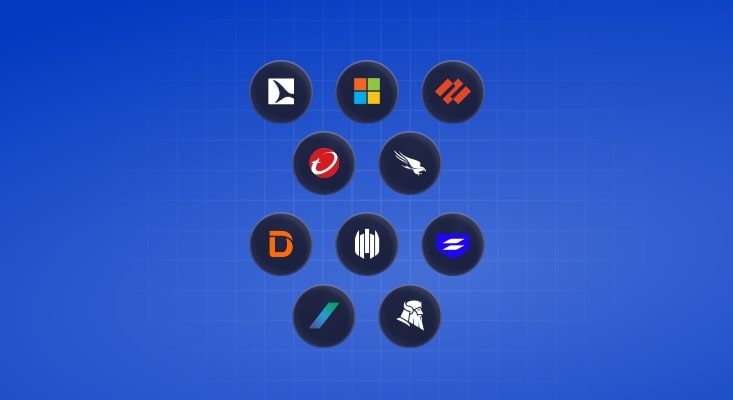
As cyber threats evolve and regulations/frameworks tighten/update, organizations can add new technology/solutions as a reaction. But over time, it can increase complexity (to manage), limit visibility, and expose them to security risks.
It is where a cybersecurity platform comes into the picture.
Let us take a closer look at cybersecurity platforms, their purpose & benefits, and some of the top cybersecurity platforms to consider.
What is a cybersecurity platform?
A security platform integrates multiple tools for security and compliance over a single environment, helping security teams easily manage/control and gain visibility of posture as opposed to addressing complexities associated with multiple security tools.
It collects telemetry/data from all the solutions/tools and responds/alerts security teams for necessary action upon detection of suspicious activities, risks, and threats.
Why must organizations use a cybersecurity platform (its benefits)?
As organizations add new solutions/tools as a reaction to the rising cybersecurity and compliance needs, it can become challenging for them to gain clear visibility of risks and establish control of all the tools. It can make them vulnerable to the risk of security drift, which can often be a silent risk that cybercriminals might exploit in the long run.
A cybersecurity platform helps address the challenge by enabling them with visibility, centralized management of all the tools/solutions, and access to insights needed for quickly responding to threats and suspicious activities across their infrastructure.
Gartner predicted that a majority of organizations will consider platformization/ consolidation for security by 2025 to address challenges like tech sprawl.
The following are some of the benefits of using cybersecurity platforms
They can help:
- Improve the precision of the detection of risks/threats.
- Manage all the tools/solutions for security and compliance.
- Boost the productivity of the security operations team.
- Reduce the overall costs associated with licensing, vendor management, etc.
- Automate routine security operations
- Reduce the time needed to respond to cyber threats.
Some facts worth considering
(Bitsight Cyber Risk and Exposure 2025) (Barracuda 2025)
- 90% of leaders found managing cyber risks harder today than five years ago.
- Only 17% of organizations reported achieving full visibility with tools to map threats regularly across environments with context.
- 65% of organizations believe that they have too many solutions, with 53% believing that they cannot be integrated.
- 80% of organizations believe that security management takes more time with tech sprawl.
- 81% of organizations find security management highly costly.
Some of the common features offered by cybersecurity platforms
- Threat detection and response
- Tool integration/management
- Identity and access management
- Security automation
- Threat analysis using artificial intelligence
- Built-in tools like EDR
The top 10 cybersecurity platforms
1. SharkStriker STRIEGO
Core focus
- Holistic human-led compliance-centric tech-driven security
Key features
- Vendor agnostic layer with flexible deployment (cloud + on-premise)
- 24×7 SOC with dual expertise in cybersecurity and compliance
- Offers a holistic platform with Next-gen tools and features (like SOAR, UEBA, SecOps,XDR, NDR)
- Automated vulnerability assessment
- Customizable, role-based dashboards
- Customizable reports
- Data sovereignty via data centers across the globe
Compliance-centric approach – offers dedicated compliance expertise for the improvement of compliance with global regulations, standards, and certifications.
SharkStriker STRIEGO offers organizations an affordable way to unify security with multiple built-in capabilities to extend their visibility, boost threat detection, automate response, and improve compliance. It gives the flexibility of both cloud native and on-premise deployment with a vendor-agnostic layer to smoothly integrate solutions across hundreds of vendors. It combines advanced technical capabilities of AI and ML and human expertise for 24/7 security against the most advanced threats. With a 24×7 SOC team with dual expertise in security and compliance backing the platform it is a must have for organizations looking to bridge their security and compliance gaps with a combination of human expertise and advanced technology.
2. Crowdstrike Falcon
Core focus
Endpoint Protection Threat Intelligence
Key features
EDR, threat hunting, cloud workload protection
Delivers most of the core functions used in NIST. It uses AI to analyze behavior instead of scanning endpoint data or emails.
3. Palo Alto Networks Cortex XDR
Core focus
Network security, cloud security, and endpoint protection
Key features
XDR, cloud security, and next-gen firewall
While Cortex XDR offers a range of features for advanced endpoint threat detection, it offers limited additional tools for other aspects of security.
4. Microsoft Defender/Sentinel
Core focus
Endpoint, M365 environment, monitoring, cloud security
Key features
Comprehensive security ecosystem integrated M365, including SIEM and XDR
Offers most tools needed from a security platform, more useful for organizations using Microsoft, maybe not as useful for organizations that rely on more than one stack.
5. Sentinel One Singularity XDR
Core focus
AI-based detection and automated response
Key features
AI-driven detection across endpoints, cloud, and identities with automated response
Singularity XDR uses AI to identify threats across cloud endpoints, network, and identities. It offers limited recovery functions within the platform. Therefore, it cannot be considered a holistic platform.
6. Trend Micro Vision One
Core focus
Endpoint protection, hybrid cloud, and network security
Key features offered
Advanced threat protection, machine learning capabilities
While the Vison One offers a lot of features and tools for the security of endpoints, network security, and cloud users often have reported finding their token-based credit system confusing, where you pay per endpoint/app/tool as opposed to a fixed monthly fee.
7. Sophos Intercept X
Core focus
Endpoint protection
Key Features
Threat hunting, automated threat investigation prioritization, and automated response
Sophos Intercept X offers a comprehensive platform to secure endpoints across the infrastructure. However, it lacks some tools beyond EDR.
8. DarkTrace Active AI
Core focus
AI-based autonomous security
Key features
Autonomous threat detection and response across networks, cloud, and email
Darktrace Active AI is known to offer comprehensive visibility across endpoints, cloud, network, and identities. However, the complicated setup and the high pricing point can be challenging for SMBs to afford.
9. Trellix Helix Connect
Core focus
Endpoint detection and response
Key features
Threat detection with MVX sandboxing technology
Trellix offers good threat detection and a platform for visibility across endpoints, email, and cloud. However, it can be resource consuming and may take some time to understand its complexity while setting up.
10. Heimdal XDR
Core focus
Proactive threat prevention
Key features
Privileged Access Management, email, and collaboration security
Threat hunting
Network security
While the Heimdal platform offers good threat prevention and ease of consolidation of tools, it can be resource intensive and challenging to perform deep manual investigations.
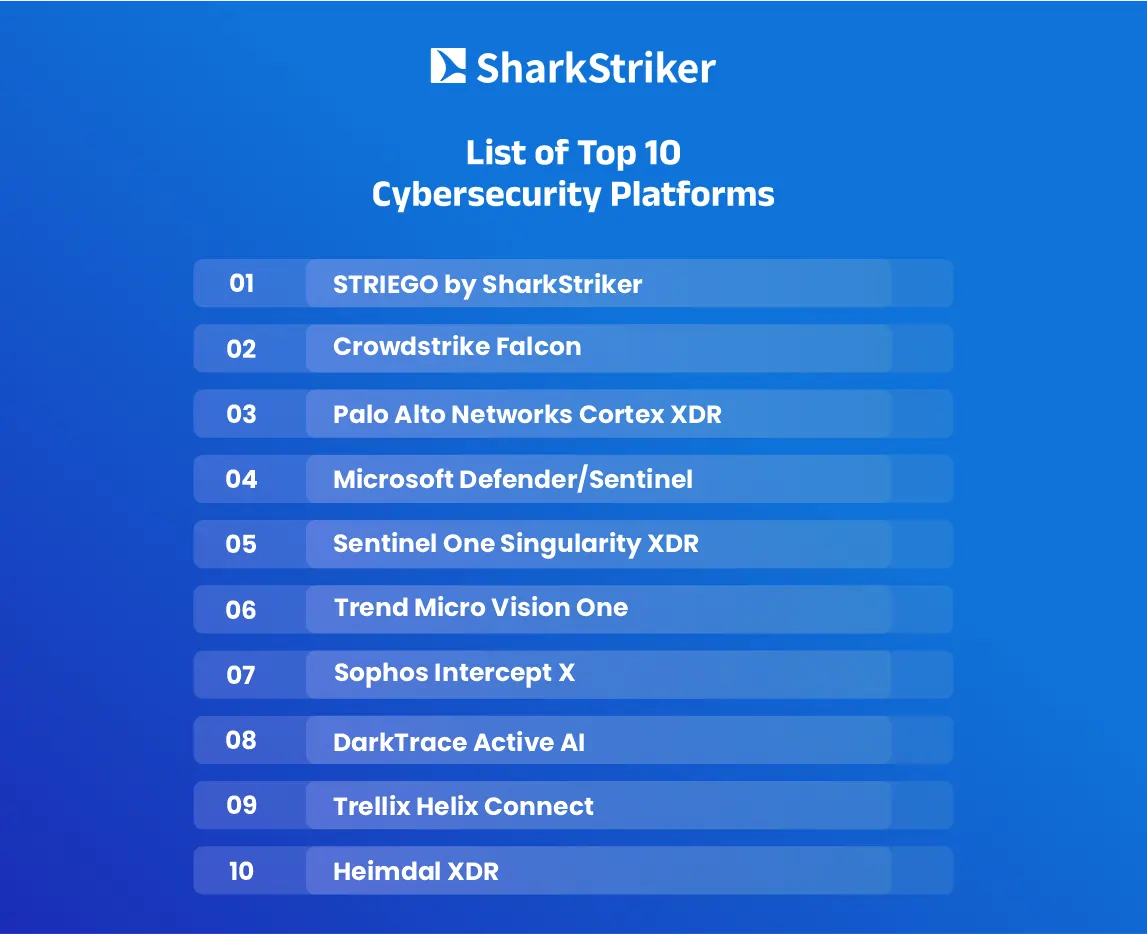
List of Top 10 cybersecurity platforms
1️⃣ STRIEGO by SharkStriker
2️⃣ Crowdstrike Falcon
3️⃣ Palo Alto Networks Cortex XDR
4️⃣ Microsoft Defender/Sentinel
5️⃣ Sentinel One Singularity XDR
6️⃣ Trend Micro Vision One
7️⃣ Sophos Intercept X
8️⃣ DarkTrace Active AI
9️⃣ Trellix Helix Connect
🔟 Heimdal XDR