Why are traditional SOCs failing the OODA loop test?
18 Jun 2026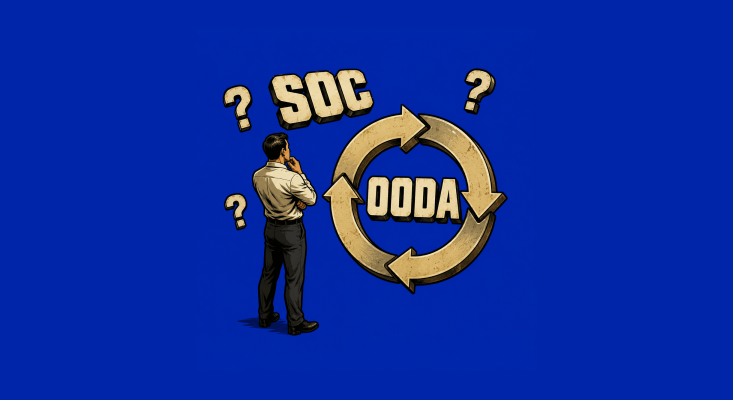
Gone are the times when threats were predictable and slow.
In 2026, threats are using AI-enabled phishing and other identity-based attacks to bypass traditional systems and move laterally across networks within minutes!
Meanwhile, SOC teams are still relying on tooling and insights that are fragmented. They are carrying out manual investigations based on limited context and following reactive response workflows. It has created a huge gap between how attackers and defenders operate.
This gap can be understood better using the OODA loop. Through this blog, we will look at what the OODA loop is from a cybersecurity POV, compare the attackers’ OODA loop with defenders, and what traditional SOC teams can do to finish the OODA loop faster.
What is the OODA loop? How does it apply to cybersecurity?
OODA is short for Observe, Orient, Decide & Act. It is a strategic framework that was developed for fighter pilots by John Boyd, a military strategist in the mid-20th century.
Here is what the different stages of OODA mean:
Observe
This is the stage at which, as a security team, you gather information. In the SOC context, it can be gathering information about an incident using telemetry (system logs, network traffic, and security alerts) and tools like vulnerability scanners, network flow analysis tools, SIEM, EDR, or any other solutions.
Orient
At this stage, you analyze the information that you gathered, correlate, and reach the context of threat (How critically it affects an organization’s assets? Is there any pattern of an attack or potential impact?). This is where you carry out the root cause analysis.
Decide
Now you answer, “What is the best thing to do in this scenario?” In cybersecurity terms, this could be escalating an alert, isolating systems, blocking identities, and initiating incident response. This is also the phase where you effectively discuss and collaborate with your team.
Act
This is the final stage where you execute the course of action that you decided. In cybersecurity terms, it could mean containment of the incident, taking remediation measures, communicating, and finally taking recovery actions. This is also the point where you use various tools for containment actions like EDR/XDR for endpoint isolation, remediation, malware removal, host cleanup, and ticketing and case management for communication.
In simple words, an organization that completes this cycle faster and more accurately gains the operational edge.
In reality, attackers are way faster using AI, leaving many SOCs behind. This mismatch in speed is concerning for defenders.
Why are traditional SOCs failing the OODA loop test?
Traditional SOCs run on an operating model that assumes that attacks will be slower with clear malware indicators, predictable network perimeters, centralized infrastructure, and human-led investigations, while modern-day cyber threats don’t operate in such a way.
They use AI-driven reconnaissance, identity-first intrusion techniques, cloud native attack paths, LoTL tactics, and automated ransomware operations. With every increase in attack speed of modern attackers, the weakness in traditional SOC becomes more visible as it struggles to finish every OODA loop.
Here’s how:
Observation
For most SOC teams, the problem isn’t a lack of data but a lack of visibility or low-quality data. Despite gaining telemetry from endpoints, cloud, firewalls, identities, SaaS, and OT environments, SOCs struggle with alert fatigue, false positive volumes, monitoring tools that are disconnected, unassessed blind spots in the cloud, and limited identity visibility.
While analysts struggle triaging for hours, real threats remain hidden, exploiting the overload faced by analysts.
Attackers use identity-based attacks, living off the land techniques, and session hijacking techniques to blend into normal activity rather than triggering obvious malware alerts. Due to delayed detection, attackers leverage increased dwell time.
How does the OODA loop break?
The SOC team that fails to accurately and timely observe threats is already behind the attacker in terms of speed.
Orientation
The real challenge is that security teams are unable to get the complete context and answer questions like what is happening, why it matters, which systems are affected, and whether something is part of a larger attack campaign. Critical context is there but fragmented across threat intelligence platforms, asset inventories, cloud monitoring tools, identity systems, and vulnerability management platforms.
How does the OODA loop break?
If attackers orient faster than defenders, then they gain a first-mover operational advantage.
Decision
For most SOC teams the decision-making is still a manual process with a typical workflow looking something like this:
By the time decisions are taken, the attacker would have already stolen credentials, moved laterally, staged data, and established persistence mechanisms. Modern attackers automate their decision-making through AI in multiple ways. They use AI-assisted phishing, automate payload selection, escalate privileges in real time, and use AI to exploit vulnerabilities. Traditional SOCs were not designed for such high-speed adversaries.
How does the OODA loop break?
Slow SOC decisions = more opportunities for attackers to operate.
Action
Even if SOC teams manage to do the observation and identification correctly, their execution often lags behind, with many organizations still struggling with manual containment workflows, poor cloud remediation capabilities, weak cross-team coordination, limited security orchestration, delayed identity revocation, and inconsistent incident response processes. The result? attackers exploit this aggressively by abusing legit credentials, hijacking cloud sessions, rotating infrastructure rapidly, maintaining multiple persistence paths, and using trusted admin tools.
How does the OODA break?
If defenders are acting slower than attackers adapt, SOC is mostly reactive.
What can SOC teams do to pass the OODA loop test?
To beat high-speed modern threats, defenders need to accelerate their OODA loop while breaking the attacker’s loop. It means observing (faster), orienting more accurately, deciding more confidently, and acting more rapidly, which means:
- Observing faster with continuous visibility across their infrastructure, with more emphasis on making accurate detections than noise.
- Orienting more accurately through contextual awareness than isolated alerts and fragmented context.
- Deciding faster by enabling analysts to focus on making decisions that matter most rather than daily operational tasks and
- Acting faster through operations made agile with a combination of AI-based automation and human expertise.
How does STRIEGO help?
STRIEGO helps SOC teams quicken their OODA loop by helping them:
Observe faster through continuous visibility across endpoints, identities, cloud workloads, SaaS platforms, OT systems, and Third-party environments through:
- single point unified telemetry from across the security stack
- threat exposure management through
- identity threat detection
- real-time behavioral analytics and
- continuous attack surface monitoring
Orient faster by offering them the contextual awareness they need through:
- Multi-sourced threat intelligence
- Holistic risk visibility across infrastructure with asset criticality mapping
- Identity risk analysis
- AI-assisted correlation and prioritization
Decide faster through:
- Automated triage
- Integrated SOAR platform
- Tailored playbooks
- AI-assisted investigation
Act faster through:
- Automated containment
- Identity/session revocation
- Cross-environment orchestration
- Dynamic segmentation
- Automated remediation workflows