Silent Train: Volt Typhoon’s covert operational framework for targeting critical infrastructure
29 Oct 2026
TL:DR
Silent Train is a covert operational framework used by the China-linked threat actor, Volt Typhoon, to target critical infrastructure. The framework uses a multi-hop network of compromised systems, devices, IoT, servers, and SOHO routers to conceal attack origins and maintain access.
Imagine a train that goes through multiple stations before reaching its destination, but instead of returning to its starting point, it disappears to an untraceable location, where it is taken apart and removed from the tracks. This is how Silent Train works.
With this blog, we will understand what the Silent Train threat is about, how it impacts organizations, and what they can do to defend.
About the threat: Silent Train
|
Threat name |
Threat type |
Threat actor |
Reported by / First identified |
Means leveraged by threat actor |
Targeted sectors |
|
Silent Train |
Covert operational framework |
Volt Typhoon |
Black Lotus Labs / November 2023
|
|
|
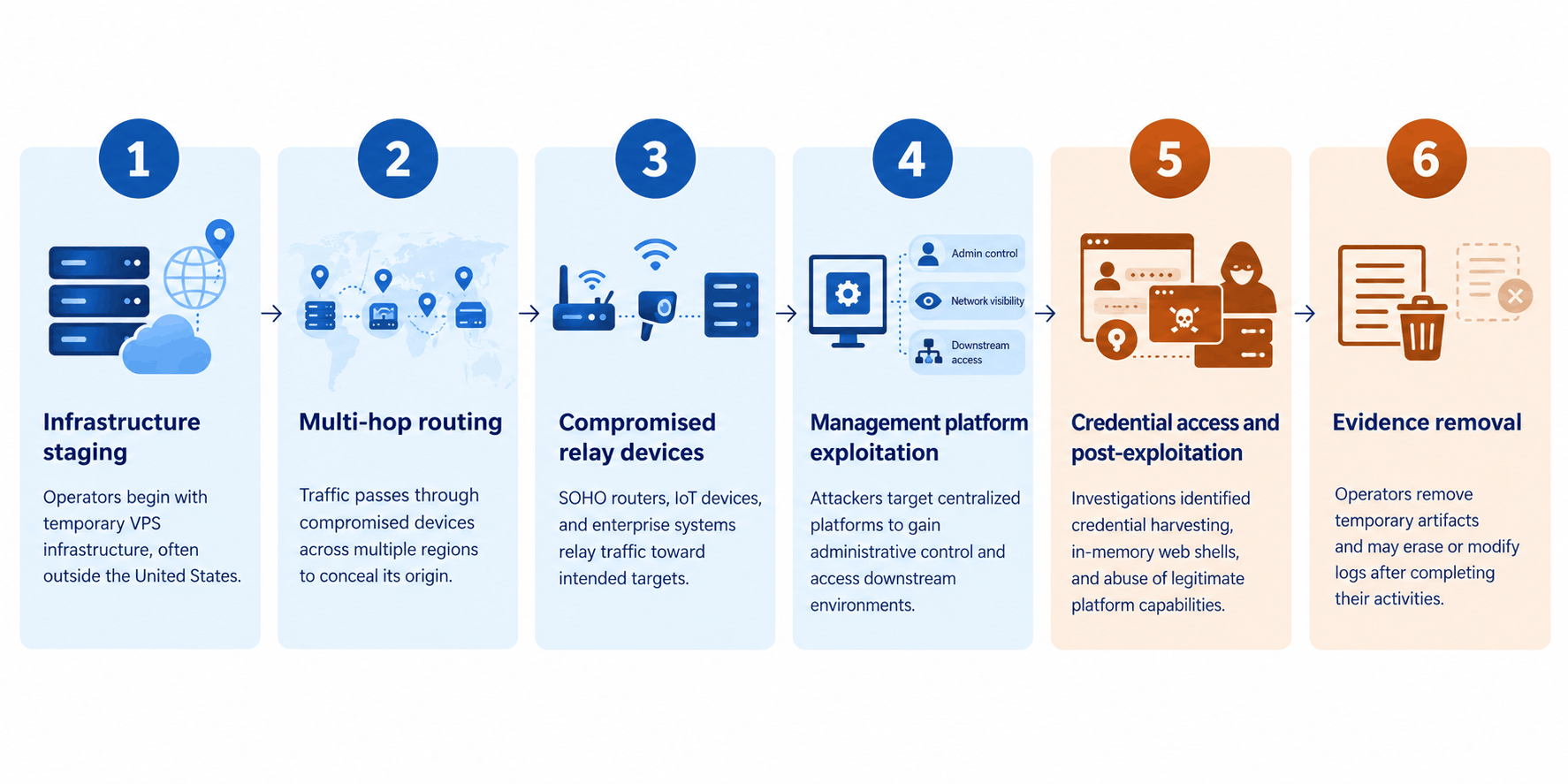
Silent Train was first identified and tracked in November 2023 by Black Lotus Labs. It uses a multi-hop network of compromised virtual private servers, small office/home office (SOHO) routers, Internet of Things (IoT) devices, and enterprise platforms. To make detection, investigation, and attribution difficult, Silent Train assembles only for specific operations and disassembles once the operation is complete. What makes it more undetectable is that it doesn’t use traditional malware, relying on legitimate system utilities, temporary SSH services, and compromised management infrastructure to conduct operations while minimizing forensic evidence.
Security researchers at Black Lotus Labs have identified hundreds of victims of Volt Typhoon across critical infrastructure and sectors like telecommunications, defense, and MSPs. Their investigation has also uncovered four confirmed zero-day exploitation campaigns and one additional likely zero-day campaign.
The following are the confirmed zero-day exploitation campaigns identified as associated with Silent Train:
- CVE-2024-39717 – Versa Director: A file-upload vulnerability previously documented in connection with Volt Typhoon activity.
- CVE-2025-8875 and CVE-2025-8876 – N-able N-central: Vulnerabilities involving insecure deserialization and command injection.
- CVE-2026-20127 – Cisco Catalyst SD-WAN Controller: An authentication-bypass vulnerability affecting the SD-WAN control plane.
- CVE-2026-16812 – Arista VeloCloud Orchestrator: An operating-system command-injection vulnerability.
How Silent Train works?
How does it impact organizations?
A successful compromise of centralized management and control-plane systems can provide attackers with access beyond an individual device.
Attackers can:
- Gain expanded administrative access: Compromised management platforms may expose connected endpoints and downstream customer environments.
- Harvest credentials: Attackers may harvest credentials to support further access or subsequent operations.
- Gain access to sensitive systems: Attackers may gain access to sensitive systems, enabling information collection or exfiltration.
- Get past detection mechanisms: Short-lived infrastructure, legitimate administrative tools, and evidence removal can complicate investigations.
- Target supply-chain and service providers: Compromising an MSP or another trusted service provider may expose connected customer environments.
The actual impact depends on the systems compromised, the privileges available, and the attacker’s objectives.
SharkStriker’s recommendations
- Patch vulnerable products: Review the vendor advisories for the vulnerabilities listed above and apply applicable security updates as a priority.
- Reduce internet exposure: Remove unnecessary public access to administrative interfaces. Restrict access through VPNs, dedicated management networks, jump hosts, and access-control policies.
- Strengthen privileged access: Review administrative accounts, permissions, trust relationships, and access granted to downstream systems.
- Improve centralized logging: Forward logs from critical network and management platforms to a protected central repository. Maintain sufficient retention to support investigations.
- Monitor legitimate tools for suspicious use: Establish baselines for administrative activity and investigate deviations, including unexpected SSH sessions, tunneling, remote file transfers, and configuration changes.
- Review third-party access: Assess MSPs and other service providers with privileged connectivity into organizational networks.
- Prepare for evidence gaps: Correlate network, identity, endpoint, and management-plane telemetry so investigations do not depend on logs from a single potentially compromised device.