OPTIMJACK – Hackers infect websites of Zoom, BBC, CNN, Salesforce, and 174 others through Optimizely
18 Nov 2026
Security researchers have identified a supply chain attack targeting Optimizely Web Experimentation, a platform that is used by organizations to build, manage, and optimize website experiences.
With this blog, we will explain what the OPTIMJACK campaign is about, its impact on organizations, and what organizations should do.
About OPTIMJACK
|
Name |
Type |
Affected component |
Initial disclosure |
Status |
|
OPTIMJACK |
Supply Chain Attack/Malicious JavaScript Injection/ Malware delivery |
Optimizely Web Experimentation – Customer projects’ custom JavaScript field and JavaScript snippets |
16 November 2026 |
|
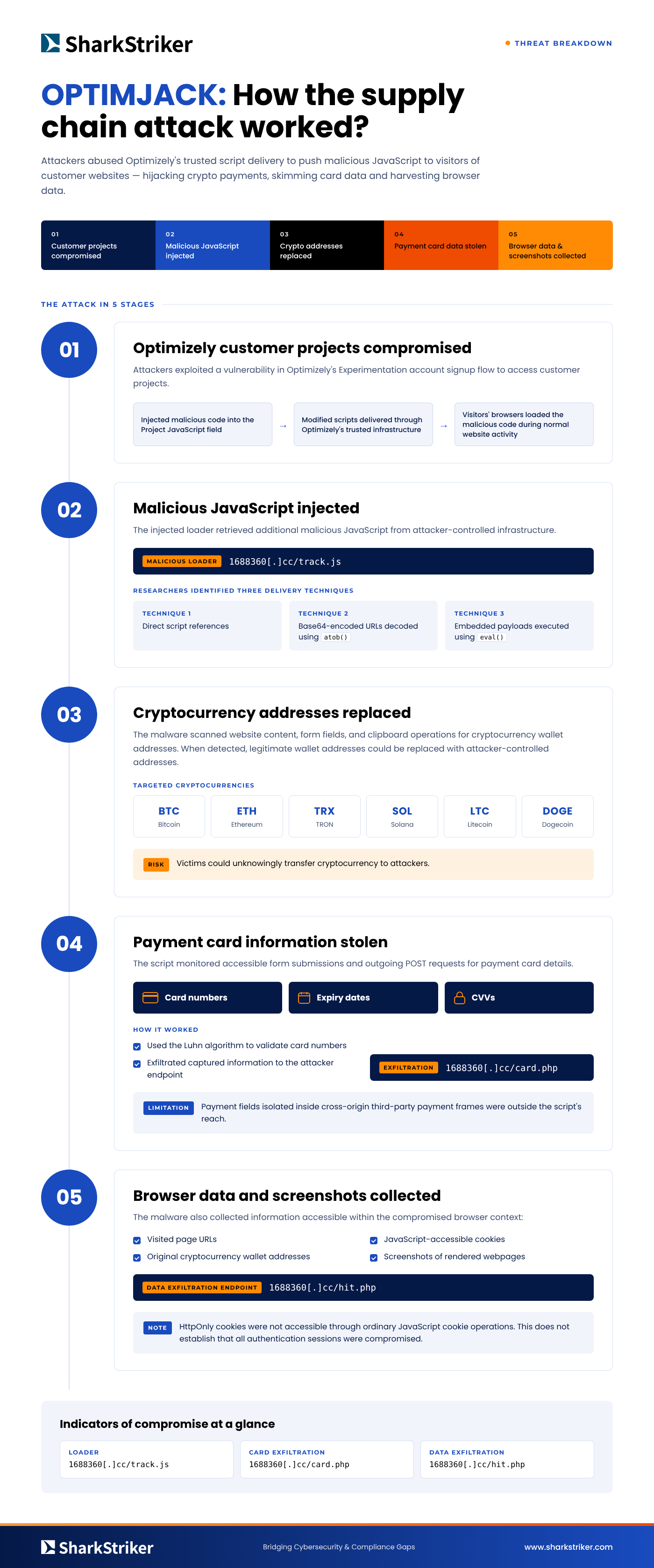
By exploiting a vulnerability in Optimizely’s Experimentation account sign-up flow, attackers gained unauthorized access to customer projects and injected malicious JavaScript into customer projects.
The JavaScript was made to:
- Steal cryptocurrency by replacing legitimate wallet addresses.
- Capture payment card information.
- Collect browser-accessible data
- Deliver exploit chains targeted at specific iPhone and iPad users.
Optimizely Web Experimentation allows organizations to run website experiments and deploy custom JavaScript through embedded snippets. Since these scripts are loaded from Optimizely’s trusted content delivery infrastructure, attackers can inject code and execute it without needing to directly modify the website application for each website.
Researchers identified 188 infected snippets after examining 1,611 Optimizely JavaScript snippets. They found that the injected code was delivered via legitimate Optimizely integrations.
This campaign was identified by Scott Helms, a security researcher from Report URI.
How could OPTIMJACK impact organizations?
Report URI identified approximately $7,040 in cryptocurrency receipts associated with attacker wallets during the observed period. This is a reported, time-specific figure and should not be treated as the campaign’s complete financial impact or a confirmed measure of total victim losses.
Through a successful attack, an attacker can:
- Steal cryptocurrency by replacing legitimate wallet addresses with attacker-controlled addresses, redirecting users to payments.
- Steal card numbers, expiration dates, and CVVs entered into accessible forms set up by them.
- Collect accessible cookies, page URLs, wallet addresses, and screenshots of website content.
- Deliver exploit chains to vulnerable iOS devices via compromised websites.
- Threaten the organization’s reputation by exposing visitors to malicious activity.
- Expand the supply chain attack’s impact by targeting a trusted third-party integration used by multiple organizations.
SharkStriker’s Recommendations
- Audit Third-Party JavaScript: Review all externally hosted scripts, including Optimizely integrations, and validate that only authorized code is being executed.
- Review Optimizely Projects: Inspect Project JavaScript configurations for unexpected modifications, unfamiliar script references, and unauthorized account activity.
- Strengthen Account Security: Enforce MFA, review administrative privileges, revoke suspicious sessions, and rotate potentially exposed API tokens and credentials.
- Implement a Restrictive CSP: Configure Content Security Policy directives to limit permitted script sources and outbound connections. Avoid unnecessarily broad trust settings.
- Monitor Payment Pages: Implement client-side security monitoring to identify unauthorized changes to payment forms, scripts, and data transmission behavior.
- Protect Cryptocurrency Transactions: Encourage users to independently verify wallet addresses before approving transfers, particularly after copying addresses from websites.
- Maintain Browser and Mobile Updates: Ensure supported browsers and iOS devices are updated to security-fixed versions.
- Monitor Third-Party Dependencies: Maintain an inventory of external scripts, analytics tools, advertising integrations, and experimentation platforms used across public-facing websites.