Insights from Gartner’s Top Cybersecurity Trends for 2026
17 Feb 2026
Gartner has recently released its prediction of 2026 cybersecurity trends. A majority of global leaders and C-suite use Gartner Inc. as a trusted source for business and technology-specific insights.
Let us look at what experts and researchers have predicted:
Top 6 Trends from Gartner’s 2026 Cybersecurity Predictions
Trend 1: Agentic AI will demand cybersecurity oversight
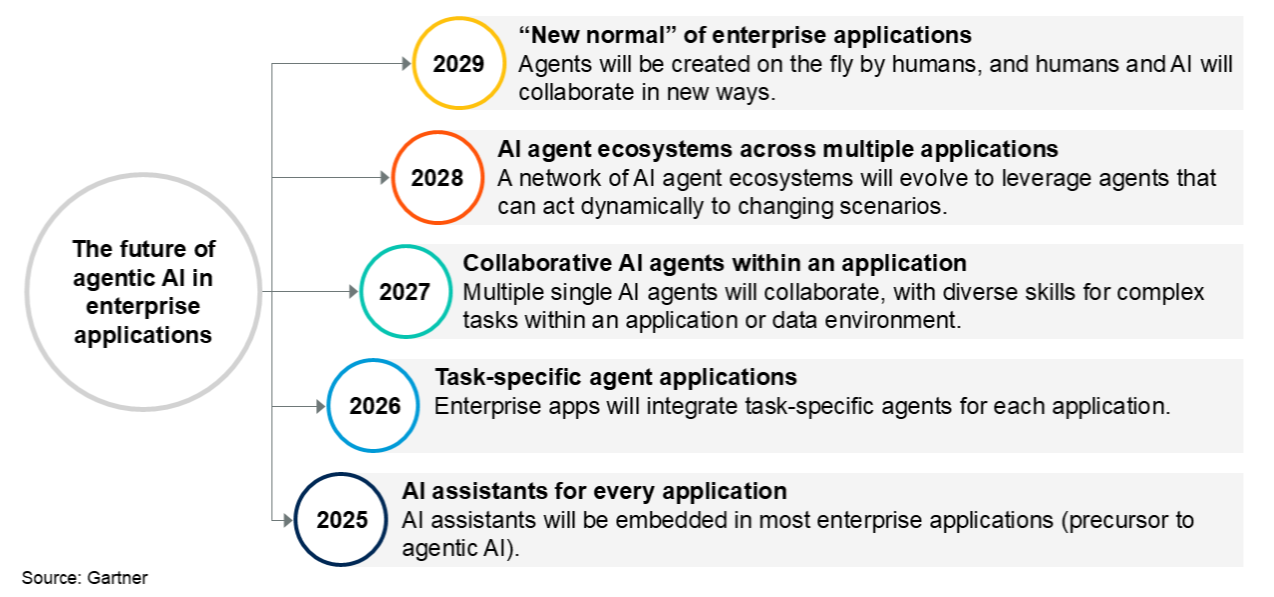
Over recent years, agentic AI adoption has risen quickly as employees across organizations globally rely on generative AI tools to boost their productivity and execute their tasks.
Gartner has predicted that a new attack surface will emerge as agentic AI and new vibe coding/no coding platforms become widely adopted in 2026.
It will elevate risks like insecure codes, unmanaged AI agents, leakage of sensitive company data (Intellectual Property data, confidential information, etc.), that could cascade into security threats and compliance violations.
Trend 2: Global regulatory volatility drives cyber resilience efforts
As geopolitics keeps shifting the global regulatory landscape, organizations will face additional pressure to adhere to the changing regulations, and they will see cyber risks and non-compliance as critical business risks that may have a significant impact on an organization’s resilience.
For example, organizations may face an added pressure to adhere to AI-specific regulations in 2026 as regulators come up with laws governing the ethical and secure use of AI.
Gartner has predicted that regulators will hold C-suite and executives accountable for compliance failures, and inaction would result in bigger penalties that could cause irrevocable reputational damage and loss of long-term business.
It has been recommended that leaders must make proactive efforts for compliance and systematically address security and compliance risks by formalizing the collaboration between the legal team, business operations, and associated vendors/third-party providers.
To further reduce compliance gaps, organizations must align their security controls with applicable local/global standards and data sovereignty goals.
There will be 30% increase in AI-related legal disputes by 2028. (Gartner, 2026)
Trend 3: Post quantum computing moves into action plans
Garter has predicted that asymmetric cryptography will become unsafe by 2030, as harvest now, decrypt later attacks grow in 2026. Many organizations rely on asymmetric cryptography to keep data and systems secure.
Asymmetric cryptography is a type of cryptography method that involves a pair of public and private keys for encryption.
Harvest now, decrypt later is a strategy that attackers use, in which they collect and store encrypted data until the future, when they can decrypt it using advancements in quantum technology.
Gartner has advised that organizations will have to use post-quantum cryptography alternatives to keep their data and systems secure to prevent breaches, legal liability, and financial loss.
It has been further recommended that leaders must prioritize investing in post-quantum cryptography alternatives early on as a proactive strategy to keep their assets secured from quantum threats before they become more frequent.
Asymmetric cryptography will become unsafe by 2030 (Gartner, 2026)
Trend 4: Identity and access management adapts to AI agents
The rise of platforms like Moltbook in 2026 shows how AI agents will not just automate threats but also accelerate them in ways that may be unpredictable. As employees deploy their own AI agents to execute tasks, they will pose multiple challenges from the rising risk of unvetted AI agents and Shadow AI to traditional Identity and Access Management challenges. Experts will have to work around IAM strategies specifically for AI agents, as they are highly unpredictable and autonomous (they may act on behalf of users).
Gartner has warned that if organizations don’t address AI-related IAM now, they may face access-related incidents when autonomous AI agents become even more prevalent. It has been recommended that leaders must take a targeted approach and focus on areas where risks and gaps are higher for ensuring innovation compliance while keeping critical assets secure in AI-centric environments.
Identity and access-related incidents will grow in 2026 when AI agents become widely adopted (Gartner, 2026)
Trend 5: AI driven SOC solutions will destabilize operational norms
While the idea of AI-driven SOC sounds interesting to organizations looking for cost optimization and productivity, it could backfire.
Organizations following the AI trend, shifting to a fully AI-driven SOC, will face new operational complexities. Gartner has predicted that AI-driven SOC will give rise to challenges like skill shortages and rising costs of AI tools.
It has been recommended that organizations should prioritize people and strengthen their workforce capabilities with human-in-the-loop frameworks in AI-supported processes. It has also been recommended that experts set clear strategic objectives for an evolving SOC.
AI-driven SOC will give rise to skill shortage, rising costs and other challenges (Gartner, 2026)
Trend 6: Gen AI will break traditional cybersecurity awareness tactics
Last year, there was a significant increase in Gen AI data breaches, with employees uploading sensitive company-related information to Gen AI tools. As AI tools become more widely and independently used for performing everyday tasks, more organizations will be exposed to Shadow AI (unvetted/unauthorized Gen AI tools)-related risks. As per Gartner, Gen AI adoption will be the primary reason for the failure of traditional cybersecurity awareness tactics.
57% of employees used personal GenAI accounts at work, with 33% admitting to inputting sensitive information (Gartner, 2026).
Gartner’s experts have recommended that employees be trained with adaptive behavioral awareness training programs that include AI tasks. It has also recommended improving governance through the authorized and vetted use of AI agents and the adoption of secure practices to reduce exposure to AI-related breaches and prevent loss of sensitive company data.