GenAI firewall vs MDR: What actually protects you when employees use AI?
08 Jul 2026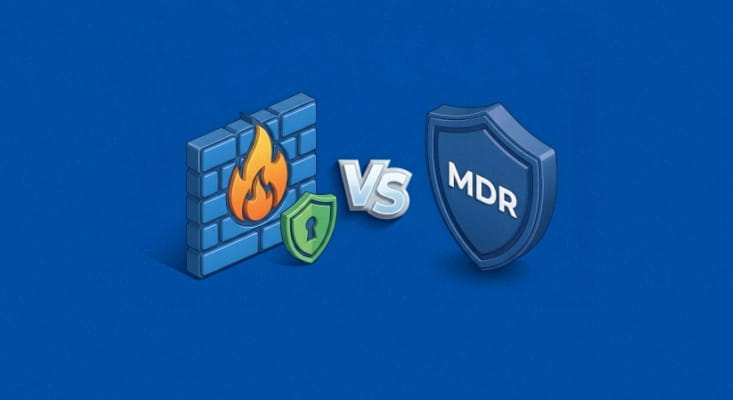
Earlier this year, security researchers found that attackers were exploiting a vulnerability in Microsoft Copilot to exfiltrate data from enterprises. No malicious files, no suspicious link, no user action, just an AI tool that was fooled into doing something malicious. Modern tools like GenAI firewalls are built to deal with such attacks.
Globally, Gen-AI tools have become part of everyday work as employees try to boost their efficiency using the tools to execute various tasks. Now the question isn’t whether organizations have a GenAI firewall, but whether it will be solely enough to solve the challenges.
Let us find out with the blog.
What are the risks of GenAI? What is actually leaking and why?
We are in a time when GenAI is no longer a stranger to anyone and is being widely used by multiple departments in organizations on an everyday basis.
A recent research conducted by McKinsey company found that over 71% of organizations use GenAI overall – from Marketing and Sales to Human Resources and Manufacturing. Gartner also predicted that more than 80% of organizations will have used generative AI APIs or have deployed GenAI-enabled applications by 2026.
A common response from security teams is blocking access to Gen AI tools, but that heightens the risk of users driving to alternatives and an increase in Shadow AI.
Some examples of how AI poses risk
- Employees copy-pasting sensitive/confidential data into ChatGPT
- Developers pushing source code to AI coding assistants
- Finance teams sharing sensitive financial data through Copilot connected to SharePoint libraries.
What does a GenAI firewall do?
Before we delve into what GenAI does, let us understand what it is. It doesn’t just exist as a single product but also as a feature in the solutions and capability within the managed security stack.
It acts as a monitoring layer between users and AI tools, monitoring what users input and what the AI tools give out. It looks for things like suspicious instances of data being leaked, malicious use of AI, or instances of prompt injection.
Its common features include:
- Prompt and response inspection
- Data Loss Prevention policy enforcement
- Access control over AI tools
While a traditional firewall or Next Gen Firewall checks for packet structure, known signatures, and anomalies in code patterns, a GenAI firewall travels inside legitimate HTTPS requests to understand context/meaning in the text.
Think of traditional firewalls as border security. They are great at finding weapons in the luggage, but GenAI firewalls are like security experts who catch contraband information in a book. While a border security official may see a book as no threat, a security expert might see it differently.
What a GenAI firewall can’t do?
Here are three things that GenAI can’t do:
It can’t detect post-compromise activity
A GenAI can prevent a malicious prompt by blocking it, but if an attacker has used an existing AI session to harvest credentials and move laterally across the network, the GenAI firewall won’t be able to see it. So, an attacker can simply move past the monitored layer without any problem.
It does not correlate activities across infrastructure
As a GenAI firewall only sees AI traffic in isolation, it has no visibility of what is happening at the endpoint, identity, or network level. So, for a GenAI firewall, a suspicious AI query and login at 2 am might look like two unrelated events.
It just enforces rules but doesn’t tell what rules are needed
For most organizations, the problem is that AI governance policies are yet to be defined. A firewall can only enforce the rules defined, not suggest what has to be defined. Therefore, it can’t catch behavioral anomalies that are outside ‘policies’ or flag risks that are not anticipated yet.
Where does MDR fill the gap?
MDR views AI security through a holistic perspective. It looks for what happens across the environment, not just what goes into and comes out of AI tools. It:
- Monitors across infrastructure, including endpoints, cloud infrastructure identity, and traffic in a single view.
- Predicts and detects compromise activity. It offers a security team that tunes SIEM to connect suspicious AI queries, lateral movement, privilege escalation, and an anomalous login at 2 AM together to detect threat activity.
- Doesn’t just enforce but also detects, recommends, and improves!
An MDR service offers the much-needed team of experts who help define specific rules and design playbooks for automated response against behavioral threats.
In addition to the above, organizations also get added benefits from SharkStriker MDR, such as:
- Unified visibility and centralized control of security with a purpose-built STRIEGO platform with dedicated features for AI risk detection & response.
- Complete oversight of security and compliance with a SOC team with dual expertise in cybersecurity and compliance that maps security controls to applicable AI-specific obligations (like the EU’s AI Act and GDPR).
- Continuous improvement through timely assessment of security posture for AI security and compliance gaps.