Top 10 cybersecurity platforms
20 Nov 2025
Imagine a car where different vendors make the engine, tires, and brakes with their own separate little interface in the console of the car. So, fixing a car means checking every console without any idea of the car’s overall health.
Many security stacks work this way. Each tool is working and doing its job, but it becomes a challenge connecting all the pieces together to make sense of the security overall.
This gap is why security platforms exist. It offers organizations a single-stop view of their security posture health by unifying telemetry from solutions across different vendors.
In this blog, we compare the top 10 cybersecurity platforms, the use cases they serve, and what to consider before choosing.
What is a cybersecurity platform?
A cybersecurity platform is a unified system that brings multiple security capabilities, such as threat detection, response, identity protection, and compliance reporting, into a single environment. It collects telemetry from endpoints, networks, cloud, and identities, correlates it, and alerts or acts on threats, replacing a patchwork of disconnected point tools.
It helps security teams easily control/manage and gain visibility into posture, helping them take timely action.
The following are some of the benefits of using cybersecurity platforms:
They can help:
- Improve the precision of the detection of risks/threats.
- Manage all the tools/solutions for security and compliance.
- Boost the productivity of the security operations team.
- Reduce the overall costs associated with licensing, vendor management, etc.
- Automate routine security operations
- Reduce the time needed to respond to cyber threats.
Why are organizations consolidating security tools?
As a reaction to threats and regulations, organizations add tools that, over time, can add complexity, limit visibility, and create a security drift that can be silent risk that attackers can exploit. Here is what the data shows:
Consolidation has become mainstream
- 70% of CISOs indicated that they are in the process of consolidating multiple solutions into one integrated platform. (IANS)
Platforms help improve detection and response speed
- Platformized organizations take 72 days less on average to detect a security incident and 84 days less to contain one. (IBM)
Complexity of managing
- 52% of executives say that complexity is the biggest challenge to security operations. (IBM)
Tool sprawl is a costly problem
- Security complexity can cost organizations more than 5% of their annual revenue. (IBM)
Quick comparison: Which cybersecurity platform is the best and for what?
|
Platform |
Best for |
|
CrowdStrike Falcon |
Endpoint-led teams wanting cloud-native detection and threat intelligence |
|
SentinelOne Singularity |
Lean teams wanting AI-driven detection and automated response |
|
Fortinet Security Fabric / FortiGate |
Organizations wanting integrated network, endpoint, cloud, and security operations |
|
Palo Alto Cortex / Prisma |
Organizations already invested in Palo Alto network and cloud security |
|
Microsoft Security / Defender / Sentinel |
Microsoft 365 and Azure-centric organizations |
|
Zscaler Zero Trust Exchange |
Organizations adopting cloud-delivered zero trust and reducing reliance on VPNs |
|
Sophos Central / Intercept X |
Small and mid-sized organizations wanting endpoint-led protection |
|
Cisco Security Cloud |
Organizations with diverse Cisco environments wanting centralized security management |
|
Trend Micro Vision One |
Hybrid environments wanting multi-layer coverage in one console |
|
SharkStriker STRIEGO |
MSPs and compliance-driven organizations wanting a vendor-agnostic platform backed by a 24×7 SOC |
The top 10 cybersecurity platforms
1. SharkStriker STRIEGO
Best for: Small, mid-sized organizations, and MSPs looking for single-stop 24×7 threat detection & response, and compliance management
What does it cover?
- Next-gen SIEM (log management, correlation, detection library)
- EDR and XDR (endpoint, network, cloud, identity, email)
- SOAR / security automation
- UEBA
- Network detection and response
- Deception technology
- Threat intelligence (including dark web monitoring)
- Attack surface management (internal and external)
- Vulnerability and patch management
- File integrity monitoring (FIM)
- CIS benchmark configuration assessment and posture assessment
- Incident management and response
- GRC and compliance management (GDPR, HIPAA, PCI DSS, NIST)
- Real-time dashboards and reporting
- MDR (24×7 SOC monitoring and threat hunting)
- Multi-tenant management (Customer, Partner, Command, and Compliance Centers)
- Vendor-agnostic integration with existing tools
How is it deployed?
On-premise. Cloud, or hybrid
Pricing model
Asset-based pricing
SharkStriker STRIEGO offers organizations an affordable way to unify security with multiple built-in capabilities to extend their visibility, boost threat detection, automate response, and improve compliance. It gives the flexibility of both cloud native and on-premises deployment with a vendor-agnostic layer to smoothly integrate solutions across hundreds of vendors to deliver centralized visibility and control without replacing the existing stack. It combines advanced technical capabilities of AI and ML and human expertise for 24/7 security against the most advanced threats. With a 24×7 SOC team with dual expertise in security and compliance backing the platform, it is a must-have for organizations looking to bridge their security and compliance gaps with a combination of human expertise and advanced technology. If you are looking for broader coverage of your infrastructure through a blend of human expertise-led, technology-driven approach, then you can consider it.
2. Palo Alto Networks – Cortex Platform
Best for: organizations that have invested already in Palo Alto network and cloud security
What does it cover?
- Endpoint protection, EDR, and XDR (Cortex XDR)
- AI-driven SIEM / SOC platform (Cortex XSIAM)
- SOAR (Cortex XSOAR)
- Attack surface management (Cortex Xpanse)
- Cloud security: CNAPP and cloud detection and response (Cortex Cloud)
- Identity threat detection and response (ITDR)
- Network traffic analysis
- Threat intelligence management
- Managed XSIAM (managed service)
- Agentic endpoint security (Koi)
- Observability (Chronosphere)
How is it deployed?
Cloud-delivered, agent-based
Pricing model
Per endpoint + data volume
Cortex integrates endpoint, network, and cloud data for advanced threat detection and works best alongside Palo Alto’s firewalls and cloud security. If you are building around the Palo Alto ecosystem then you can consider it. Its value outside the ecosystem is less clear, so confirm the products your use case actually needs.
3. CrowdStrike Falcon
Best for: Teams that prioritize endpoints with cloud native detection and threat intelligence
What does it cover?
- Endpoint and mobile security (NGAV, EDR, XDR)
- Cloud security (CNAPP: workload, posture, application, and data security posture management)
- Identity protection (ITDR)
- Exposure management (vulnerability management and attack surface management)
- Next-Gen SIEM and log management
- Data protection
- SOAR and IT automation
- Firewall management
- Threat intelligence
- MDR (Falcon Complete)
- Charlotte AI (generative AI security assistant)
How is it deployed?
Cloud-native, single lightweight agent
Pricing model
Modular, per endpoint
Falcon started with endpoint protection and now it also covers cloud workload, identity, and threat intelligence modules. It is best for teams that are looking for fast detection and threat hunting. If you are looking for endpoint-first coverage, then this platform is for you. If you are looking for breadth beyond endpoint, then you need to map your needs and priorities before you select the modules for licensing.
4. Microsoft Defender XDR + Sentinel
Best for: Organizations that have deployed Microsoft 365 and Azure
What does it cover?
- Defender XDR (endpoint, email and collaboration, identity, and cloud apps)
- Cloud security (Defender for Cloud: CSPM, servers, containers, databases, storage)
- IoT and OT security
- SIEM and SOAR (Sentinel)
- Identity and network access (Entra, including Internet Access and Private Access)
- Data security, governance, and compliance (Purview)
- Privacy management (Priva)
- Endpoint and device management (Intune)
- Security for AI
- Security Copilot (AI security assistant)
How is it deployed?
Cloud-native
Pricing model
Bundled licensing/ Data ingested
With deep integration across the Microsoft ecosystem, Microsoft Security offers extended detection through Defender XDR and cloud native Sentinel SIEM. If your environment is Microsoft-centric, native telemetry is an advantage worth considering. However, if you run other vendors, third-party integration is possible but takes more engineering, and costs can scale with log volume so plan ingestion accordingly. It is why many organizations pair it with Managed Security for Microsoft.
5. SentinelOne Singularity
Best for:
Lean teams that are looking for AI-driven detection and automated response
What does it cover?
- Endpoint protection (EPP, EDR, automated response)
- Cloud security (CNAPP, CSPM, workload and data protection)
- Identity threat detection and response (ITDR)
- AI SIEM and data lake
- XDR
- Purple AI (generative AI SOC assistant)
- Threat intelligence
- MDR
How is it deployed?
- Cloud-delivered console
- Agent-based
Pricing model
Tiered, per endpoint
SentinelOne Singularity offers AI-driven detection across endpoints, cloud workloads and identifies with automated response actions that help reduce manual tirage. It is for teams that have limited analysts capacity. Consider it if you want strong AI-based autonomous response but before committing, confirm if the tier you choose covers recovery and rollback.
6. Sophos Central
Best for: Small and Medium-sized organizations that are looking for endpoint-led protection
What does it cover?
- Endpoint, server, and mobile protection (Intercept X)
- XDR
- MDR
- Next-gen firewall
- ZTNA
- Email security
- Web security
- Wireless
- Web application firewall
- Cloud security
- Encryption
How is it deployed?
Cloud hosted console (Sophos Central)
Pricing model
Per user/device, tiered by edition
Sophos Intercept X combines endpoint protection with automated threat investigation and response administered via a single cloud console. It is for teams that want straightforward management. You can consider it if your needs are endpoint centric.
7. Fortinet Security Fabric
Best for: Organizations looking for integrated network, endpoint, cloud, and security operations.
What does it cover?
- Next-gen firewall (FortiGate)
- SD-WAN
- Secure switching and wireless (FortiSwitch, FortiAP)
- SASE (FortiSASE)
- Endpoint security and EDR/XDR (FortiClient, FortiEDR)
- Email security (FortiMail)
- Web application firewall (FortiWeb)
- Network access control (FortiNAC)
- Identity and MFA (FortiAuthenticator, FortiToken)
- SIEM and analytics (FortiSIEM, FortiAnalyzer)
- Centralized management (FortiManager)
- Cloud security
- OT security
- Threat intelligence (FortiGuard)
How is it deployed?
- Hardware
- Virtual
- Cloud
- As-a-service
Pricing model
Product, subscription, and consumption-based (FortiFlex)
By connecting FortiGate with Fortinet’s other security portfolio, Fortinet Security Fabric offers centralized visibility and coordinated protection across network, endpoint, cloud, and security operations. It is for teams that are looking for a consolidated ecosystem that combines networking and security into one.
8. Zscaler Zero Trust Exchange
Best for: Large organizations looking to replace VPNs with zero trust access
What does it cover?
- Secure internet and SaaS access (ZIA)
- Zero trust private app access (ZPA)
- Digital experience monitoring (ZDX)
- Cloud firewall, IPS, and sandbox
- Zero trust branch, campus, and factory connectivity (including segmentation)
- Zero trust cloud (workload protection and posture control)
- Data protection (DLP, CASB, DSPM, browser isolation)
- Privileged remote access
- Deception
- Unified vulnerability management and risk quantification (Risk360)
- Agentic SecOps
- AI security
- Cellular and IoT security
- Business continuity
How is it deployed?
Cloud-native
Pricing model
Subscription-based
Zscaler Zero Trust Exchange offers identity and context-based connection to users, devices, applications, and workloads. If your organization is large-sized and are looking to replace perimeter and VPN based access with Zero trust, then you should consider this platform.
9. Cisco Security Cloud
Best for: Organizations with diverse Cisco environments looking for centralized security management
What does it cover?
- Network firewall (Secure Firewall)
- Workload and cloud security (Hypershield, Multicloud Defense, Secure Workload)
- Secure access and DNS security (SSE/SASE, Umbrella)
- Identity and access (Duo MFA, ISE network access control)
- Endpoint security (Secure Endpoint)
- Email security
- XDR
- SIEM and SOAR (Splunk)
- Network detection (Secure Network Analytics)
- Threat intelligence (Talos)
How is it deployed?
Cloud-native with hybrid and on-premise support
Pricing model
Subscription and product-based
Cisco Security Cloud offers Cisco’s security capabilities across network, cloud, endpoint, identity, and security operations. You can consider it if you already use Cisco security and networking products and want a unified security ecosystem.
10. Trend Micro Vision One
Best for: Large and medium sized organizations looking to consolidate security across endpoint, network, cloud, identities, and data
What does it cover?
- Cloud security posture management (CSPM)
- Agentless cloud workload protection and vulnerability management (CWPP)
- Cloud infrastructure entitlement management (CIEM)
- Data security posture management (DSPM)
- Code and application security (ASPM, IaC, CI/CD pipelines, container registries and images, code-to-cloud correlation)
- Runtime threat detection and response (Wiz Defend)
- Attack path analysis (Security Graph)
- AI security (AI-SPM, AI application protection, AI-BOM)
How is it deployed?
Cloud-hosted
Pricing model
Credit-based licensing
Trend Micro Vision One correlates telemetry across endpoint, email network, and cloud security with XDR. It is for medium-sized to large sized organizations that want to manage security in complex IT environments. Consider it if you want a security platform for managing security across enterprise infrastructure.
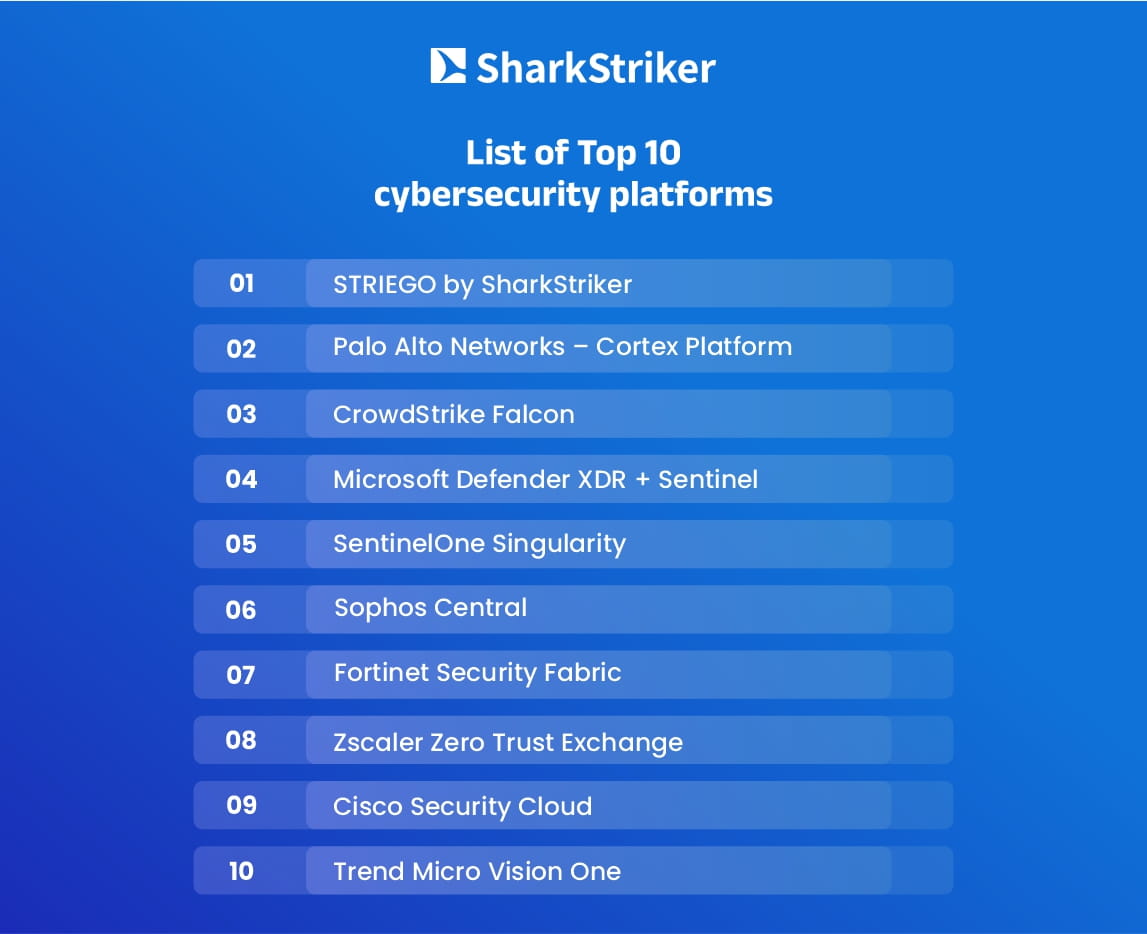
List of Top 10 cybersecurity platforms
1️⃣ STRIEGO by SharkStriker
2️⃣ Palo Alto Networks – Cortex Platform
3️⃣ CrowdStrike Falcon
4️⃣ Microsoft Defender XDR + Sentinel
5️⃣ SentinelOne Singularity
6️⃣ Sophos Central
7️⃣ Fortinet Security Fabric
8️⃣ Zscaler Zero Trust Exchange
9️⃣ Cisco Security Cloud
🔟 Trend Micro Vision One