Imagine running a fast-food chain.
Every time you open a restaurant, you send guys for commissioning, security, and making sure everything is working as it is supposed to.
But what if you expand to multiple cities at once and the inspection process is no longer able to keep up?
Some of your restaurants can go live without being checked.
All this, while your old restaurants fail to follow standards and procedures that were part of the original inspection. A mishap in one restaurant can quickly turn into a financial and reputational disaster.
Similarly, somewhere in your client environment there’s an exposed cloud bucket, a forgotten subdomain, or an unpatched internal server that nobody is tracking. And you have no way to find it and fix it. That is the gap between you and the most in-demand cybersecurity services in the market – attack surface management.
Through this edition of the Journal, we will understand what attack surface management is about and how MSPs can make the most of the revenue opportunity it offers.
What attack surface management actually means?
It means continuously monitoring everything that could be exploited by attackers.
This includes both internal and external attack surfaces – from domains, subdomains, cloud storage, and exposed APIs (external) to misconfigured devices, unpatched systems, and legacy applications.
ASM is to protect you from what you don’t know about from within and outside the perimeter, unlike a firewall or antivirus that protects what you already know about.
Cloud adoption, shadow SaaS, remote work, and M&As might have quietly expanded the attack surface for your client.
Blind spots can occur overnight or over the years:
- A department that has subscribed to a tool without the IT team’s approval
- A cloud bucket deployed for a one-off project but never decommissioned
- A company acquires a small business and inherits its infrastructure
How do you build and sell ASM?
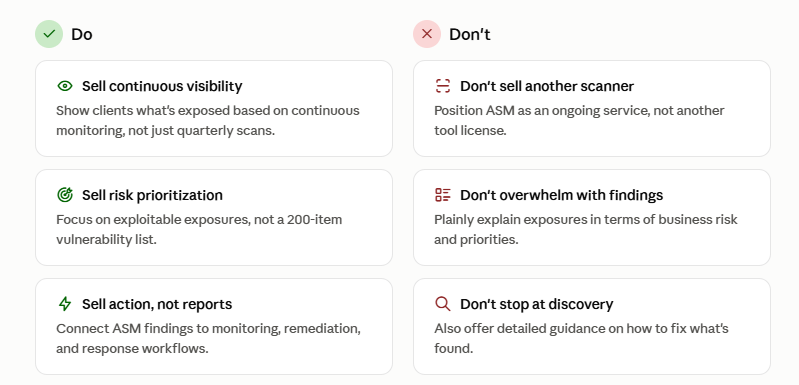
ASM is an emerging and highly demanded cybersecurity offering. It is the part where most MSPs can offer a differentiator in a crowded market. It is not just about reselling a scanning tool. Here are core differentiators to offer:
Continuous monitoring
- Monitoring internal and external assets continuously. No more leaving gaps with quarterly assessments!
Exposure prioritization
- Rank exposures based on real-world risk, not just raw vulnerability counts.
Detection integration
- Instead of keeping ASM separate, feed ASM findings into existing monitoring and response workflows.
Plain-language reporting
- Offer a plain explanation of risks to clients instead of handing them a report they can’t make anything of.
This way, you can make ASM a high-margin service as opposed to just a tool.
Selling ASM as an MSPs: The Dos and Don’ts
Delivering it without building it yourself
For most MSPs, the challenge does not even start at selling. It starts with having the team or a platform to run continuous internal and external monitoring on their own.
SharkStriker’s Partner Program removes this barrier by offering a fully white-labeled team and platform sold under their own brand.
Why ASM resides inside MDR not beside it?
While standalone ASM tools are good at finding exposure they are not built to act on it.
When exposure discovery feeds sits inside the same platform that runs detection and response instead of a dashboard that waits until you notice, you can timely act.
STRIEGO helps you do that by keeping exposure feeds inside monitoring loop, correlated against threat data and everything else in the environment.
Your client’s ASM findings, MDR, and SIEM data all on one platform (STRIEGO) so they don’t have to switch between disconnected tools.
With human experts acting on it, you don’t just offer a tool that is finding exposure but also the expertise to act on it.
If you are an MSP looking to add internal and external surface monitoring to your service stack, connect with us.
To learn more about our partner program.