ShieldBreak – A local privilege escalation/security bypass flaw in Microsoft Defender’s Malware Protection Engine
12 Aug 2026
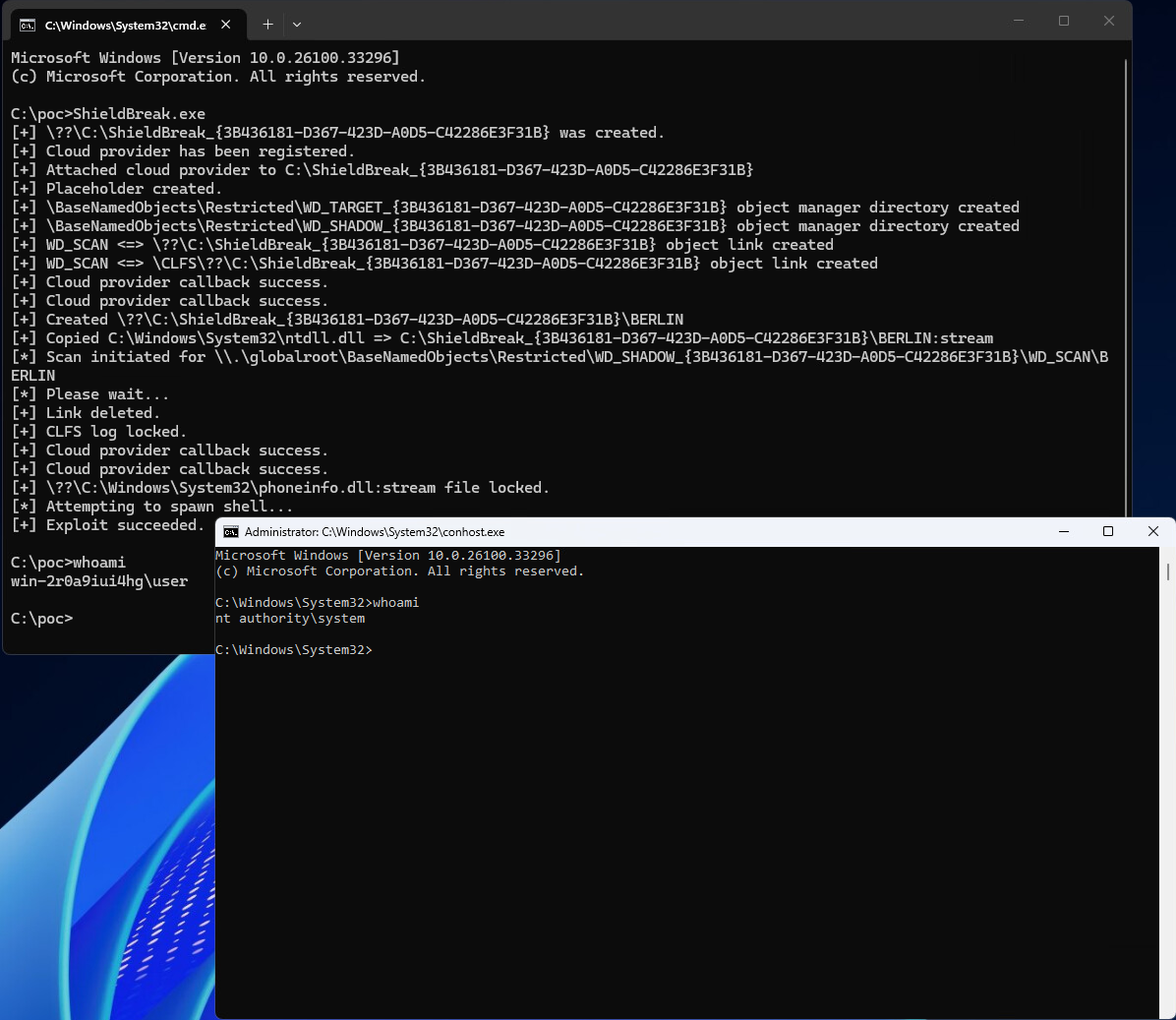
Security researchers have disclosed a new proof-of-concept for a zero-day flaw titled Shieldbreak that bypasses Microsoft’s remediation for CVE-2026-50656, also known as RoguePlanet, a privilege escalation vulnerability that affects the Microsoft Malware Protection Engine.
Through the blog, we will understand what zero-day vulnerability is about, the threats posed by it, along with some security recommendations that organizations can use to defend against it.
About the vulnerabilities
Microsoft previously released an update to address RoguePlanet (CVE-2026-50656), a local privilege escalation flaw that affected its Malware Protection Engine.
However, according to a new Proof of Concept released by security researchers, the vulnerability can still be exploited despite applying the patch.
The published research reports are based on successful testing by the researchers in Windows 11 25H2 and Windows Server 2025 environments, meaning that organizations operating these environments can face a potential security gap.
|
Vendor + component affected |
Potentially exposed environments |
CVEs |
About |
|
Microsoft +
Malware Protection Engine
|
|
Unassigned |
A local privilege escalation/security feature bypass vulnerability. |
Threats posed by the vulnerability
A typical attack can potentially follow this path:
By exploiting this vulnerability, an attacker can:
- Escalate privileges locally
- Compromise endpoints
- Gain unauthorized access to credentials and sensitive information
- Install malware
- Establish a mechanism for persistence
- Move laterally across the network
- Use the elevated privileges to further orchestrate attacks
Security teams should pay particular attention to:
- Unexpected SYSTEM-level process creation
- Suspicious privilege escalation from standard-user processes
- Unusual activity involving Microsoft Defender components
- Attempts to interfere with or tamper with security controls
- Suspicious command-line or PowerShell activity following privilege escalation
- Credential access and other post-exploitation activity following SYSTEM execution
SharkStriker’s recommendations
- Monitor for unexpected SYSTEM-level execution, particularly where a low-privileged process results in SYSTEM privileges or unusual activity involving MsMpEng.exe (Microsoft Defender Antivirus Service).
- Hunt for anomalous activity involving Microsoft Defender processes.
- Investigate endpoints where the ShieldBreak PoC or related tooling may have been executed.
- Ensure endpoint telemetry is centrally collected and monitored.
- Continue applying Microsoft’s latest Defender and Windows security updates.